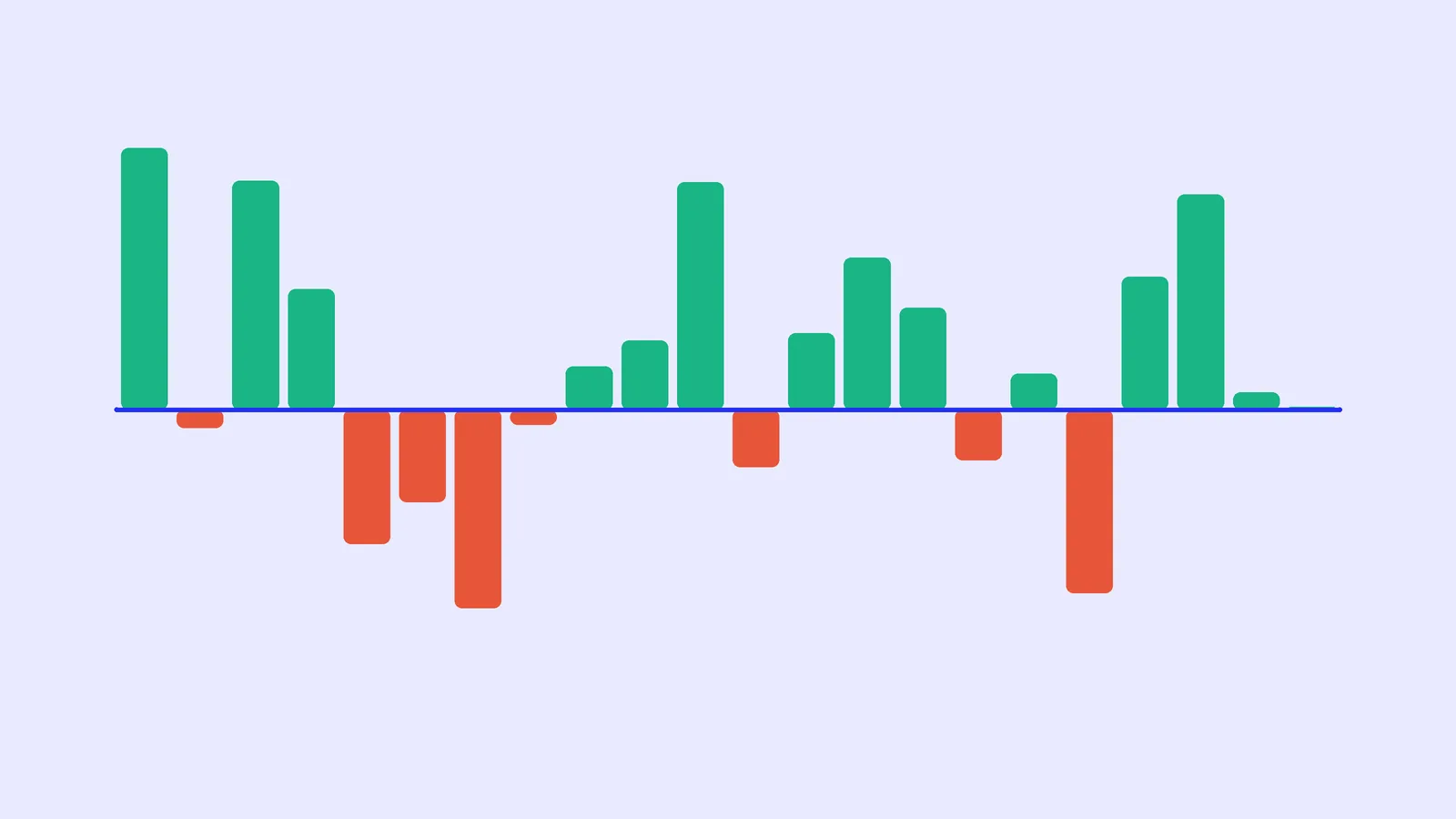
Bitcoin exchange inflow is the amount of BTC sent from outside wallets to wallets that belong to exchanges over a set period. Net flow is inflow minus outflow: a positive number means more coins arrived at exchanges than left, and a negative number means more left than arrived. A deposit makes coins available to trade but is not a sale, so net flow is context and not a signal.
Where the numbers come from
Every Bitcoin transfer is public, but addresses do not carry names. Analysts work out which addresses belong to which exchange and attach a label to them. Once an address is labelled, any transfer into it counts as an exchange deposit and any transfer out of it counts as a withdrawal.
Adding those transfers up over a period gives three figures:
Inflow = total sent to exchange wallets
Outflow = total sent from exchange wallets
Net flow = inflow − outflow
A worked example
Round numbers for illustration, not live data.
Over 24 hours, 12,000 BTC arrive at exchange wallets and 9,000 BTC leave.
Net flow (24 hours) = 12,000 − 9,000 = +3,000 BTC
Over the last 7 days, 60,000 BTC arrived and 68,000 BTC left.
Net flow (7 days) = 60,000 − 68,000 = −8,000 BTC
The two windows disagree. The day shows a net inflow and the week shows a net outflow. Neither is wrong. The short window picks up one busy day, and the long window shows the broader direction.
What a percentile adds
A raw figure such as +3,000 BTC is hard to judge. A percentile ranks it against history.
If today's net inflow is at the 90th percentile, it is larger than 90% of past readings. That is unusual. If it is at the 50th percentile, it is an ordinary day. In the example above, +3,000 BTC might be at the 55th percentile, which would mean the inflow is routine despite sounding large.
Why coins move to and from exchanges
A deposit can have several purposes: to trade the coins, to post them as collateral for a derivatives position, to move them from one venue to another, or to use an exchange service. A withdrawal can mean a move to a personal wallet, to another exchange or to a custodian.
Exchanges also shuffle coins between their own wallets for security and housekeeping. If both ends are labelled correctly, those moves cancel out. If one end is unlabelled, they show up as a flow that never really happened.
How to use it in CryptoPith
- Open Exchange Flow Context. It is available on the Pro plan.
- Read the net flow to exchanges over the last 24 hours.
- Read the net flow over the last 7 days and note whether the two windows agree.
- Check the percentile against history for each figure, so you know whether the reading is typical or rare.
- Keep in mind that the figures are built from labelled transfers. CryptoPith's transfer data covers four networks: Bitcoin, Ethereum, Solana and BNB Chain.
- Look at the data source and the time it was checked, which CryptoPith shows with every figure.
Common mistakes and limits
- Trusting the labels too much. The figure is only as good as the wallet labels. Exchanges open new wallets all the time, and a wallet that has not been labelled yet is invisible to the count.
- Reading a deposit as a sale. A transfer is not a trade. Coins can sit on an exchange untouched or serve as collateral.
- Reading a withdrawal as long-term holding. Coins that leave one exchange may arrive at another service the next day.
- Comparing different sources. Each data provider keeps its own label set, so two honest sources can show different totals for the same day.
- Leaning on one window. A single large transfer can dominate a 24-hour figure.
- Forgetting the history behind a percentile. A percentile is relative to the period it is measured against, and exchange activity has changed a lot over the years.
This article is educational and is not financial advice.
FAQ
What does a high Bitcoin exchange inflow mean?
It means more BTC than usual was sent to exchange wallets in the period. Those coins are now available to trade, but the data does not show whether they were traded. Check the outflow as well, because a high inflow with an equally high outflow is a net flow near zero.
Is a Bitcoin exchange outflow a bullish sign?
Outflows are often read as coins moving into long-term storage. That is one possible explanation among several, and the data cannot tell them apart. An outflow describes where coins went, not what their owners plan to do.
What is the difference between exchange inflow and net flow?
Inflow counts only coins arriving at exchanges. Net flow subtracts the coins that left over the same period. Net flow is usually the more useful figure because it shows the balance of the two.
How accurate is exchange flow data?
It is an estimate. Accuracy depends on how complete and current the wallet labels are, and no label set covers every exchange wallet. Use the direction and the percentile as rough context instead of treating the exact number as precise.
Related tools: Stablecoin flow monitor, Derivatives pulse and Why is it moving?. Your first AI report in CryptoPith is free.