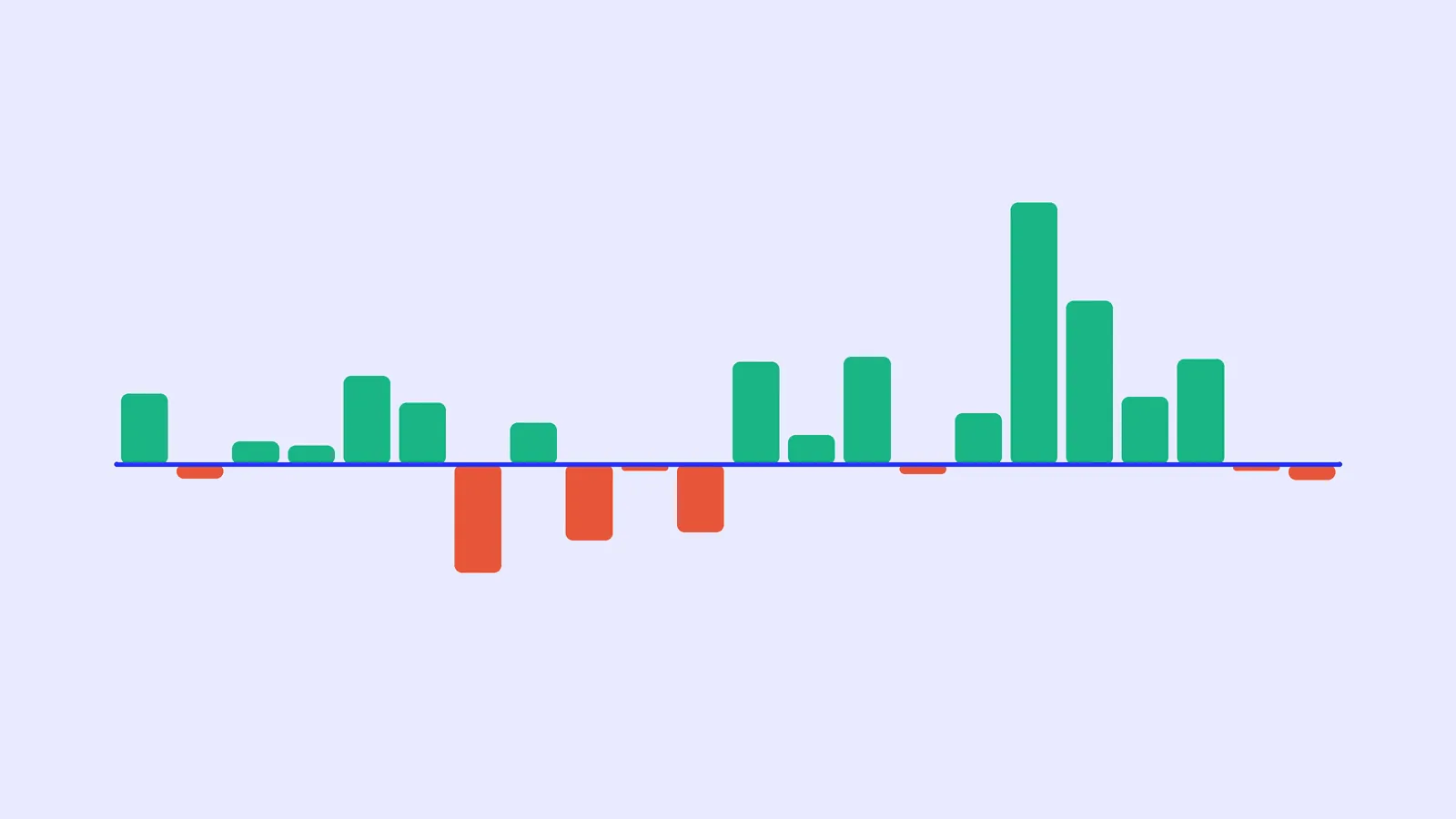
A USDT supply chart shows how many Tether tokens exist over time. Supply rises when the issuer mints new tokens and falls when tokens are burned after a redemption, so the chart is a rough gauge of how many dollars sit inside the crypto market. A large mint is often read as new money about to enter the market, and that reading is frequently wrong.
How stablecoin supply works
A stablecoin is a token designed to hold the value of one unit of a currency, usually one US dollar. USDT is issued by Tether and USDC by Circle.
Supply changes in two ways:
- Mint. A customer sends dollars to the issuer, and the issuer creates the same number of tokens.
- Burn. A customer returns tokens to the issuer and receives dollars. The returned tokens are destroyed.
The same stablecoin exists on several blockchains at once. Each network has its own supply, and the total is the sum of all of them. That is why a supply chart is usually split by network.
The calculations
Net change = supply at the end − supply at the start
Change (%) = net change / supply at the start × 100
Example with round numbers, not live data: a stablecoin's total supply goes from 100 billion to 103 billion tokens in 30 days. The net change is +3 billion, or +3%.
Now split the same example by network:
| Network | Start | End | Change |
|---|---|---|---|
| Network A | 60 billion | 64 billion | +4 billion |
| Network B | 40 billion | 39 billion | −1 billion |
| Total | 100 billion | 103 billion | +3 billion |
Looking at Network A alone, you would see a 4 billion increase. Looking at the total, you see 3 billion. Part of the growth on Network A may simply be tokens that moved over from Network B.
Why a mint is not automatically new buying
There are at least four reasons a mint can appear without fresh demand for crypto behind it.
- Inventory mints. An issuer can create tokens ahead of time and keep them in its own treasury wallet until customers ask for them. Tether describes such tokens as authorized but not issued. They exist on the blockchain but are not yet in anyone else's hands.
- Moves between networks. Tokens can be burned on one blockchain and minted on another. The total stays the same, but a feed that watches one network will report a large mint.
- Other uses. Stablecoins are also used for payments, savings, lending and as collateral. Dollars that become stablecoins are not necessarily on their way to an exchange.
- Timing. Even when a mint does reflect real demand, nothing says when the tokens will be spent, or on what.
The same caution applies in reverse. A burn means someone redeemed tokens for dollars. It does not show why they did it.
How to use it in CryptoPith
- Open the Stablecoin Flow Monitor. The result is free.
- Read the change in USDT supply and in USDC supply.
- Look at the split by network to see where supply grew and where it shrank.
- Check the large mints and burns.
- Look at the data source and the time it was checked, which CryptoPith shows with every figure.
- On Pro, turn on alerts.
Common mistakes and limits
- Treating a mint as a signal. A mint is not automatically new buying, for the reasons above.
- Watching one network. A single-network view can show a jump that vanishes in the total.
- Reading single events. One large mint says less than the direction of total supply over weeks.
- Assuming supply growth causes price moves. Supply and prices have often risen in the same periods, but both can be responding to the same wider conditions.
- Forgetting what is not covered. USDT and USDC are the two largest dollar stablecoins, but they are not the whole stablecoin market.
This article is educational and is not financial advice.
FAQ
What does a Tether mint mean?
It means new USDT tokens were created on a blockchain. That can reflect customer demand, but it can also be the issuer restocking its own treasury wallet or tokens being moved from another network. The mint alone does not tell you which.
Is a rising USDT supply bullish?
It is often read that way, because growing supply means more dollars have been converted into stablecoins. Supply growth does not say whether or when those tokens will be used to purchase crypto. Treat it as background, not as a signal.
What is the difference between a mint and a burn?
A mint creates new tokens when dollars are deposited with the issuer. A burn destroys tokens when they are redeemed for dollars. Net supply change is mints minus burns.
Why is stablecoin supply different on each network?
Each blockchain keeps its own record of the tokens issued on it. Users choose networks for reasons such as fees, speed and where the applications they use are, so supply is spread unevenly and shifts over time.
Related tools: Exchange flow context, Altcoin season index and dominance and Why is it moving?. Your first AI report in CryptoPith is free.