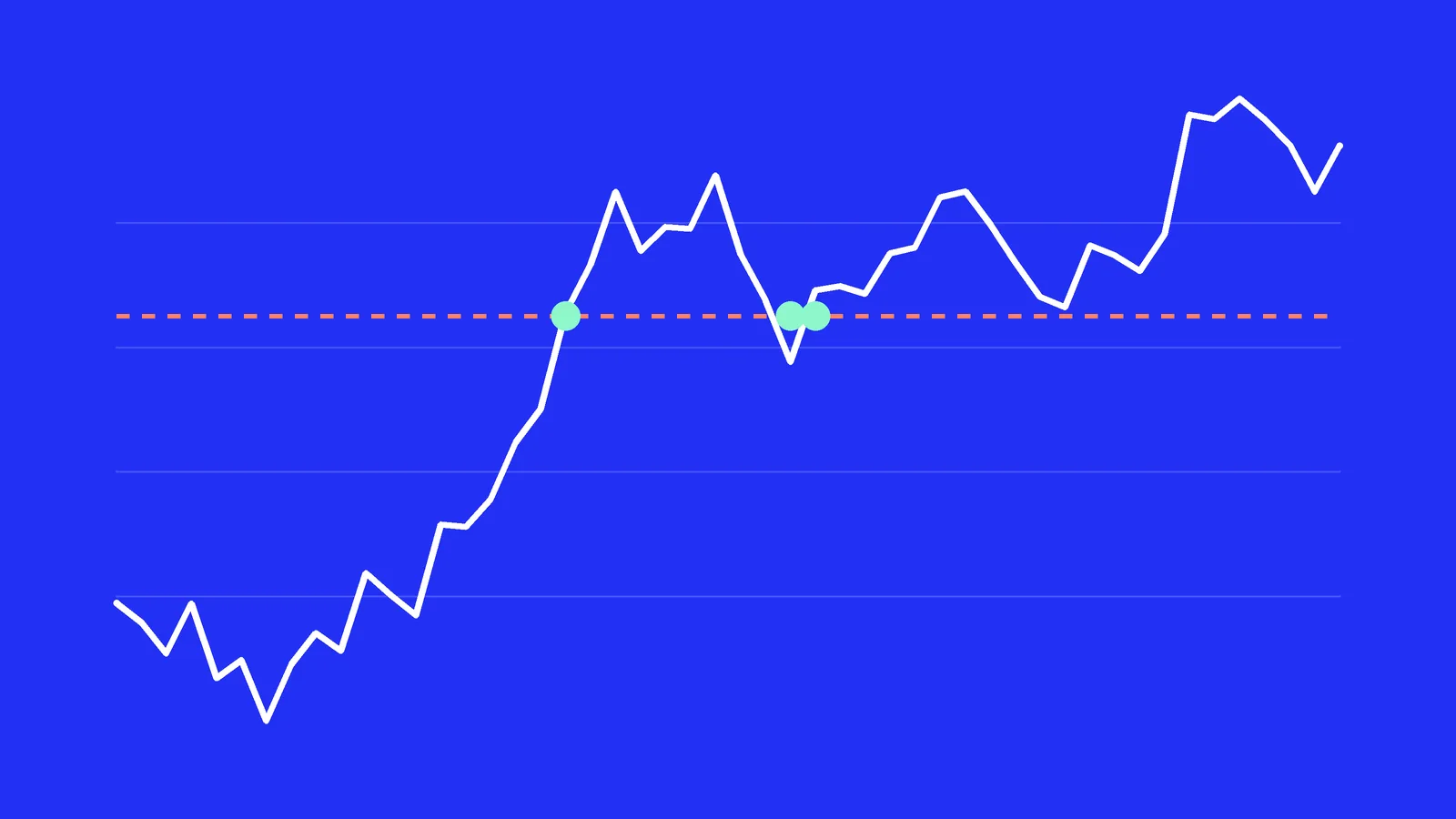
A crypto price alert sends you a message when a coin crosses a price you chose, so you do not have to watch the chart. Alerts can also follow other conditions, such as an RSI level or unusual volume. An alert tells you that something happened. What it means is still for you to work out.
This article is educational and is not financial advice.
The main types of alert
Price alerts. You pick a level and a direction. With a coin at $100 (example), one alert might fire if the price rises above $110 and another if it falls below $92.
RSI alerts. The Relative Strength Index measures momentum on a scale from 0 to 100. The formula is:
RS  = average gain / average loss over the period (usually 14 candles)
RSI = 100 - 100 / (1 + RS)
Example: if the average gain over 14 candles is 2 and the average loss is 1, RS is 2 and RSI is 100 - 100 / 3 = 66.7. Readings above 70 are commonly called overbought and readings below 30 oversold. RSI depends on the timeframe, so the 1-hour RSI and the daily RSI of the same coin are different numbers.
Unusual volume alerts. Volume is unusual only in comparison with what is normal for that coin. A common way to measure it is against a recent average. Example: if the average volume of the last 20 candles is 1,000 coins and the current candle shows 3,000, volume is three times its average.
Whale transfer alerts. These report large transfers on a blockchain, for example a big deposit to an exchange.
New AI report and news alerts. These tell you that there is something new to read about a coin you follow.
Choosing levels that mean something
An alert is most useful at a level where your view of the market would change. A price that cancels a scenario in a report is a natural candidate. So is the edge of a range that has held for weeks.
Alerts placed without a reason create noise. If your phone buzzes twenty times a day, you stop reading the messages, and the one that matters gets lost with the rest. A few well-chosen alerts work better than many.
It also helps to decide in advance what you will check when an alert fires. For a price alert that might be volume and the wider market. For an RSI alert it might be the trend on a longer timeframe.
A worked example
The figures are an example only.
A coin has moved between $90 and $110 for a month and trades at $100. You are not interested in the middle of the range, so you set three alerts:
- price above $110, the top of the range;
- price below $90, the bottom of the range;
- daily RSI above 70, to hear about strong momentum even if the price has not left the range.
Three alerts cover the events that would change the picture. Twenty alerts at every $1 step would report the same range twenty times.
How to use it in CryptoPith
- Choose what the alert follows: price, RSI, unusual volume, whale transfers, new AI reports or news.
- Set the condition, for example a price level or an RSI value.
- Choose where the alert is delivered: in the app, by email or in Telegram.
- On Pro and above, the Alert Backtest tool shows, before you save an alert, how many times it would have fired in the last year and what the price did afterwards.
Price alerts are part of Pro ($14 a month) and the higher plans. The advanced alert types are part of Premium ($34 a month) and Elite. Plans are paid in crypto and nothing renews automatically.
Common mistakes and limits
- Treating an alert as an order. An alert is a message. CryptoPith does not trade and does not connect to exchanges, so an alert never opens or closes a position. It is not a stop-loss.
- Reading RSI above 70 as a signal. In a strong trend RSI can stay above 70, or below 30, for a long time. The reading describes momentum. It does not say the move is over.
- Mixing timeframes. An RSI alert on the hourly chart will fire far more often than the same alert on the daily chart.
- Assuming instant delivery. Emails and messages take time to arrive, and the price can keep moving in the meantime.
- Reading a whale alert as a trade. A transfer is not a buy or sell signal.
- Over-trusting a backtest. How often an alert fired last year is history, not an expectation for next year.
FAQ
How do I get an alert when bitcoin hits a certain price?
Create a price alert for Bitcoin, set the level and choose where the message should go. In CryptoPith, alerts can arrive in the app, by email or in Telegram. Price alerts are part of the Pro plan and above.
What RSI level should I set an alert at?
The levels people use most are 70 and 30, because they are the conventional overbought and oversold lines. There is no correct level. The same number means different things on different timeframes and in different trends.
Can crypto alerts be sent to Telegram?
Yes. CryptoPith delivers alerts in the app, by email or in Telegram.
Is an RSI alert a buy or sell signal?
No. It tells you that momentum reached a level you chose. Trend, volume, news and many other things affect what happens next.
Related tools: Alert backtest, Macro and crypto event calendar and Learn mode and glossary. Your first AI report in CryptoPith is free.