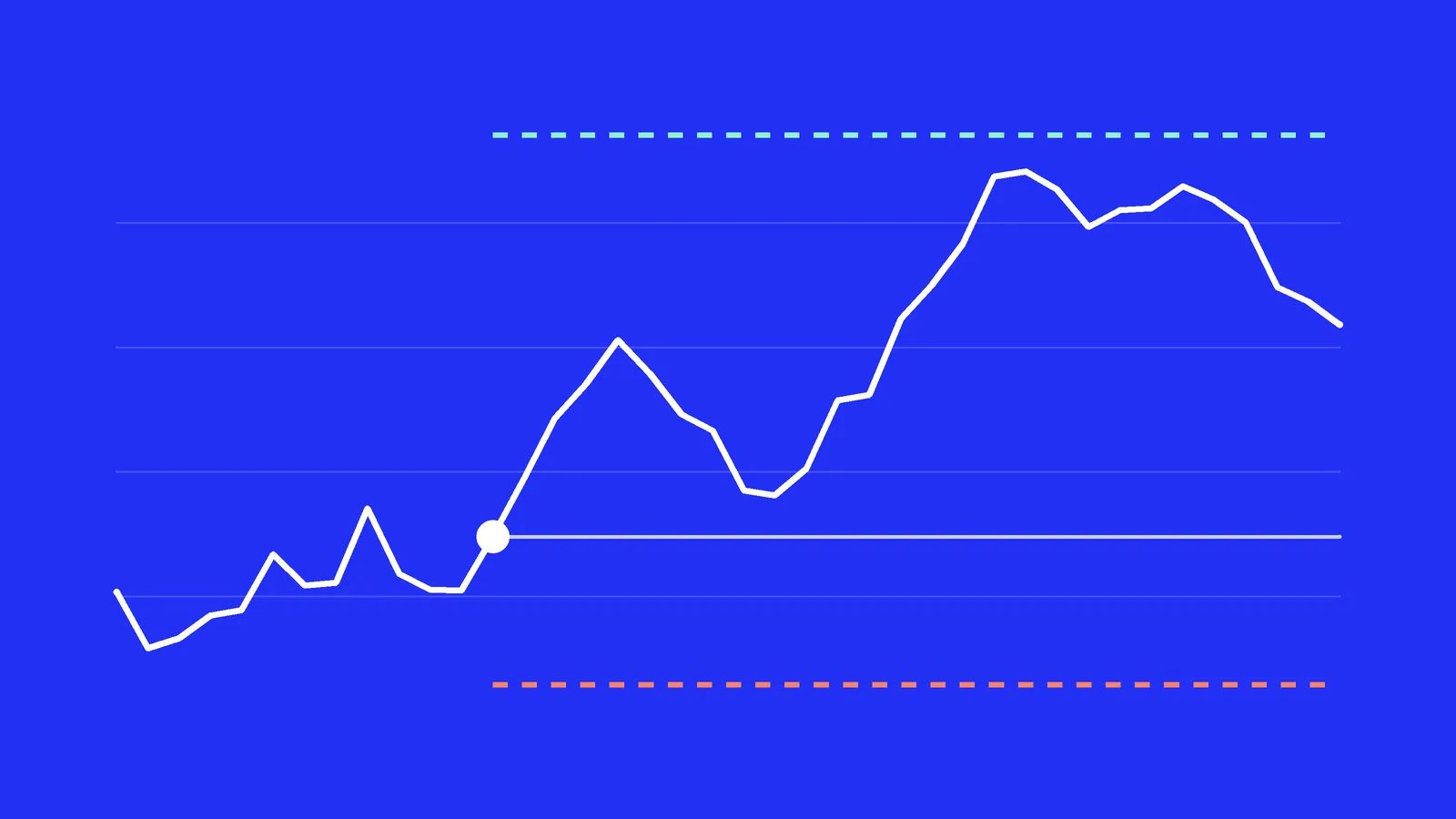
Position size is the amount of a coin held in one trade, chosen so that hitting the stop costs a fixed share of the account. The formula is the amount at risk divided by the distance between the entry price and the stop price. A position size calculator runs that formula for you.
This article is educational and is not financial advice.
The formula
Four inputs are needed: the account size, the risk per trade as a percentage, the entry price and the stop price.
amount at risk = account size × risk per trade (%)
risk per coin  = entry price - stop price   (for a short: stop price - entry price)
position size  = amount at risk / risk per coin
position value = position size × entry price
The idea is to fix the loss first and let the size follow. The stop is the price at which the trade idea is considered wrong. The risk percentage is the share of the account you accept losing if that happens.
A worked example
The numbers are examples with round figures.
An account holds $10,000. The risk per trade is 1%. The entry price is $100 and the stop is at $95.
- Amount at risk: 10,000 × 1% = $100
- Risk per coin: 100 - 95 = $5
- Position size: 100 / 5 = 20 coins
- Position value: 20 × 100 = $2,000
If the price falls to $95 and the position is closed there, the loss is 20 × $5 = $100, which is 1% of the account.
Now change only the stop.
| Stop | Risk per coin | Position size | Position value |
|---|---|---|---|
| $98 | $2 | 50 coins | $5,000 |
| $95 | $5 | 20 coins | $2,000 |
| $90 | $10 | 10 coins | $1,000 |
The amount at risk is $100 in every row. A tighter stop allows a larger position, and a wider stop requires a smaller one. The size comes from the stop distance, not from how confident anyone feels.
Why the risk percentage matters
Losses come in runs. The table shows what is left of an account after ten losing trades in a row at different risk levels. This is plain arithmetic, not a forecast.
| Risk per trade | Left after 10 losses in a row |
|---|---|
| 1% | 90.4% |
| 2% | 81.7% |
| 5% | 59.9% |
| 10% | 34.9% |
A small percentage keeps a bad run survivable. A large one does not.
Risk and reward
People often search for a risk-reward calculator alongside position size. The ratio compares the possible gain with the possible loss.
risk-reward ratio = (target price - entry price) / (entry price - stop price)
In the example, with a target of $115, the ratio is (115 - 100) / (100 - 95) = 3. This is usually written as 1:3. A trade risks $100 to make $300 if the target is reached.
The CryptoPith calculator returns position size and amount at risk. The risk-reward ratio is a separate sum that you can do by hand from the same entry and stop plus a target.
How to use it in CryptoPith
- Enter your account size.
- Enter the risk per trade as a percentage.
- Enter the entry price.
- Enter the stop price.
- Read the two results: position size and amount at risk.
The Position Size Calculator is a free tool and needs no sign-up. It is educational and places no orders. CryptoPith does not trade and does not connect to exchanges.
Common mistakes and limits
- Ignoring slippage and fees. The calculator does not include them. In a fast market a stop can be filled at a worse price than the one you set, so the real loss can be larger than the amount at risk shown.
- Moving the stop after sizing. If the stop is moved further away once the trade is open, the loss grows beyond what was planned.
- Entering the wrong account size. Use the capital that is actually set aside for trading, not a figure you hope to have.
- Counting related trades separately. Several positions in coins that move together can all hit their stops on the same day. The combined risk is then several times the single-trade figure.
- Confusing position size with leverage. Position size decides how much is lost at the stop. Leverage decides how much margin has to be posted. With leverage, the liquidation price also has to be further away than the stop.
- Treating the stop as guaranteed. A stop order is triggered when a price is reached. It does not promise the price at which the position is actually closed.
FAQ
How do I calculate position size in crypto?
Multiply your account size by the percentage you accept losing on one trade. Divide the result by the distance between the entry price and the stop price. The answer is the number of coins.
What percentage should I risk per trade?
There is no figure that is right for everyone. The example in this article uses 1% because it keeps the arithmetic simple. The table of losing runs shows how quickly larger percentages reduce an account.
Does leverage change position size?
Not in this formula. For the same position size and the same stop, the loss is the same with or without leverage. Leverage changes how much of your own money is tied up as margin and adds a liquidation price.
What is a risk-reward ratio?
It is the possible gain divided by the possible loss on a trade. A ratio of 1:3 means the distance to the target is three times the distance to the stop. A ratio says nothing about how likely the target is.
Related tools: Liquidation price calculator, Crypto profit calculator and Correlation matrix. Your first AI report in CryptoPith is free.