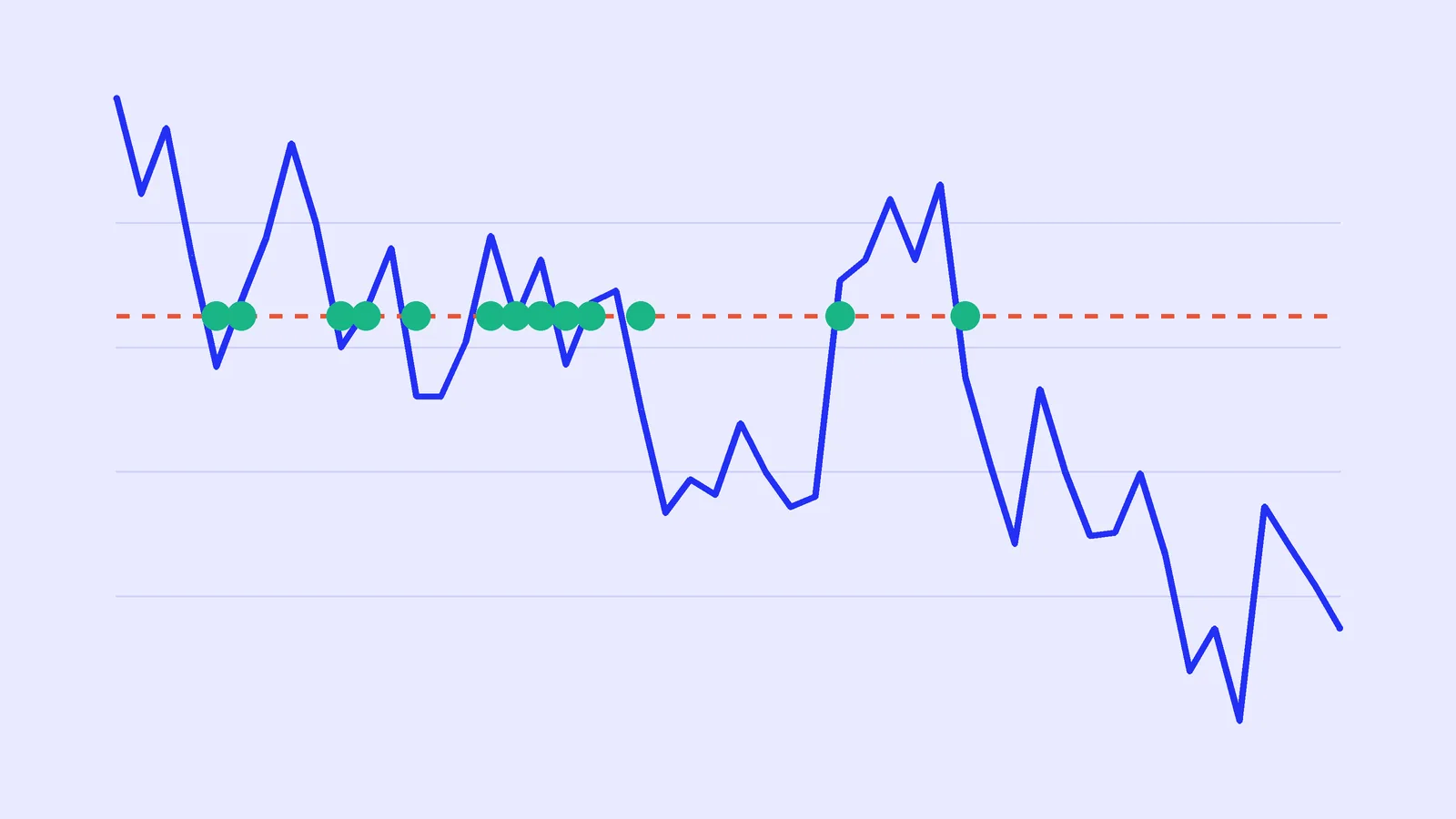
To backtest a crypto alert, apply its condition to past price data, count how many times it would have fired, and record what the price did after each firing. The result tells you whether the alert is too noisy, too rare or about right, and how varied the outcomes were. It is a record of the past year, not an expectation for the next one.
What an alert backtest is
An alert has three parts: an asset, a timeframe and a condition. "Bitcoin, daily chart, RSI closes below 30" is one alert. "Ether, price crosses above 4,000" is another.
A backtest replays history against that condition. It produces two things:
- Frequency. How many times the condition was met.
- What followed. The price change after each of those moments.
Most people set alerts by feel and then find out weeks later that the alert fires every other day, or never. A backtest answers that question before the alert is saved.
The calculations
The price change after an alert is a simple percentage.
Change after N days (%) = (price N days later − price at the alert) / price at the alert × 100
Many alerts use the Relative Strength Index (RSI), so it helps to know what it measures. RSI compares recent gains with recent losses, usually over 14 periods, on a scale from 0 to 100.
RS = average gain / average loss
RSI = 100 − 100 / (1 + RS)
By convention, readings below 30 are called oversold and readings above 70 overbought. Those are labels for how one-sided recent moves have been. They are not instructions.
A worked example
The numbers below are an example only, not real results.
Alert: a coin's daily RSI(14) closes below 30. Over the past year it would have fired 6 times. Seven days after each firing, the price change was:
| Firing | Change after 7 days |
|---|---|
| 1 | +8% |
| 2 | −5% |
| 3 | +3% |
| 4 | −12% |
| 5 | +6% |
| 6 | +2% |
Summary: 4 of 6 cases were positive. Sorted from lowest to highest, the values are −12, −5, +2, +3, +6, +8, so the median is halfway between +2 and +3, which is +2.5%. The range runs from −12% to +8%.
How to read it honestly:
- Six cases is very few. One more negative outcome would turn "4 of 6" into "4 of 7".
- The range is wide. A median of +2.5% hides a case that lost 12%.
- If firings 2, 3 and 4 all happened in the same fortnight, they are really one market episode counted three times.
How to use it in CryptoPith
- Start setting up an alert and choose its condition. Alert Backtest is available on the Pro plan.
- Before you save the alert, run the backtest.
- Read how many times the alert would have fired in the last year.
- Read what the price did after those firings.
- If the alert would have fired far too often or almost never, change the condition and run the backtest again.
- Save the alert once the frequency suits how often you want to be interrupted.
Common mistakes and limits
- Treating history as expectation. The backtest shows history, not what to expect. The same condition can be followed by very different outcomes next year.
- Forgetting that one year is one environment. If the past year was mostly rising, nearly every alert will look good. If it was mostly falling, nearly every alert will look bad.
- Small samples. An alert that fired five times has not been tested in any meaningful sense.
- Counting clusters as separate cases. Conditions such as low RSI tend to occur several days in a row. Those firings are not independent.
- Tuning until it looks perfect. If you adjust the threshold until last year looks ideal, you have fitted the alert to the past. That fit rarely carries forward.
- Confusing an alert with a trade. An alert is a notification. The backtest does not include fees, slippage or any decision you might have made afterwards.
This article is educational and is not financial advice.
FAQ
What is backtesting in crypto?
Backtesting means applying a fixed rule to historical data to see what would have happened. For an alert, the rule is the alert condition, and the output is how often it fired and how the price moved afterwards. It describes the past and cannot confirm that the rule will behave the same way again.
How many signals does a backtest need to mean something?
There is no fixed number, but a handful is not enough. A common rule of thumb in statistics is around 30 independent observations before averages start to be reasonably stable. Most single-coin alerts over one year fall well short of that, which is a reason for caution.
Does a good backtest mean the alert will work?
No. A good backtest means the condition coincided with favourable price moves in one particular year. Markets change, and a result based on a few cases can be down to chance.
What is a good RSI level for an alert?
The conventional levels are 30 and 70, but no level is best. A stricter level such as 25 fires less often, and a looser one such as 35 fires more. A backtest shows that trade-off for the coin and timeframe you picked.
Related tools: Historical analog finder, Report scorecard and Learn mode and glossary. Your first AI report in CryptoPith is free.